
Serendipity & the Lonely Generation
For a person my age, one of life’s greatest paradoxes is that as the world has become increasingly more connected through the internet, we become increasingly lonelier.
More people live alone than ever.
More people see friends less.
More people talk to strangers less.
In the US, 1 in 4 adults under the age of 45 feel lonely. Moreover, the loneliest demographic is 18-22 year-olds.
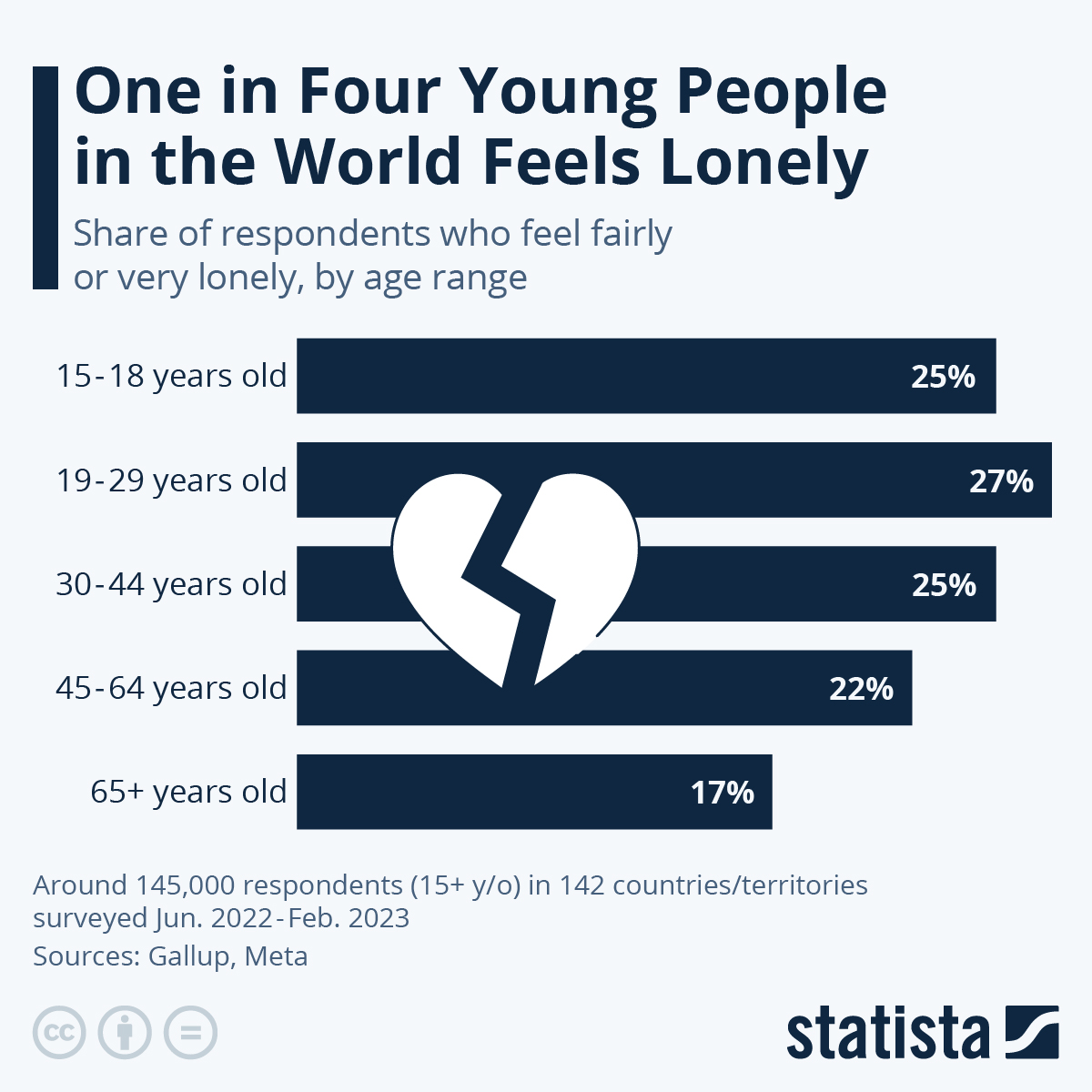
Here’s a startling fact: Loneliness increases the chance of dying by 32%.
Why are people so lonely?
I find that the typical answer to this question is unproductive, most having to do with how the world is increasingly polarized, driven by a terribly beautiful algorithm. And while these answers hold truth, they feel like non-solutions. Yes, algorithms create addictive and polarizing environments, but is the solution to remove the algorithms? No, that doesn’t seem to be what the market wants.
I think the answer is a little bit more profound:
As the world becomes more digitized, we lack serendipity.
I had a fantastic coffee chat the other day with a friend who works in urban design. Recently, he went to a design conference themed around urban structures with less rigidity: not just having one straight path, but a multitude of paths and places for inspiring serendipitous moments:
Running into a friend.
Seeing someone with a cool t-shirt.
Witnessing an event you hadn’t heard of.
…
When we’re walking in a straight line, or driving in our own mechanical bubble, these moments happen less.
Moreover, when we’re scrolling on our phones, these moments happen less.
I believe that these moments are a key part of us forming relationships with more depth and becoming less lonely.
So, how can we design for serendipity? Well, it depends on the context. In my context as a college student, here’s a solution:
Restricting phone usage in social contexts…
Growing up, I viewed phone bans in schools as antiquated. The modern cell phone is an incredible tool, and the moment we get out of the classroom context, we’ll continue to use it. Instead of banning it, why not integrate it into the curriculum? I also questioned the severity of social media on youth. Unlike what popular opinion suggests, I wasn’t affected by the social media metrics of likes and followers. I also didn’t feel like my friends were (to the extent portrayed).
Over time, I’ve come to realize that the downsides of social media are consistently misrepresented.
Opportunity cost is the main pitfall of addictive algorithms.
The problem is not that people are using these apps. It’s what they could have been doing if they weren’t.
This phenomenon occurs in many group environments I’m in:
Group activity ends.
People sit around awkwardly.
Everyone takes out their phones and starts scrolling.
What would they be doing if they didn’t have that escape route? Would someone cut that awkward silence and start a conversation? My guess is: yes.
Therefore, I think a potential solution is implementing more bans on phones in clubs, or (and this may be more implementable) creating structures conducive to serendipity: perhaps an incentive program throughout the semester focused on meeting new people in the club and forming deeper connections.
Rather than only reinforcing horizontal expansion (meeting new people), perhaps we have a doubly phased approach: first horizontal, and then vertical (increasing the depth of an individual relationship).
I believe that this vertical expansion element is key to decreasing loneliness.
This is because curing loneliness requires relationships with a certain level of depth. Horizontal expansion is easier than vertical: to meet someone new is easy compared to building a relationship with depth and trust. These things take more time, and more sacrifice. However, I believe this sacrifice is incredibly worth it - a 32% decrease in the risk of death is a powerful motivator.
I’m doing what I can to verticalize. To increase the quantity of my serendipitous moments.
Sometimes I fall short.
Recently, my life has felt reminiscent of a heart beat. Lonely and flat with bursts of energy and joy. I struggle to get out of my head, to take a third-person perspective on myself. I’ve become immensely self-critical. This brings me into the concept of self-love, which I’ll save for another post.
However, I embrace this pain and struggle. Where would we be without the yin?
Here’s to a brighter future full of depth, joy, and good problems.